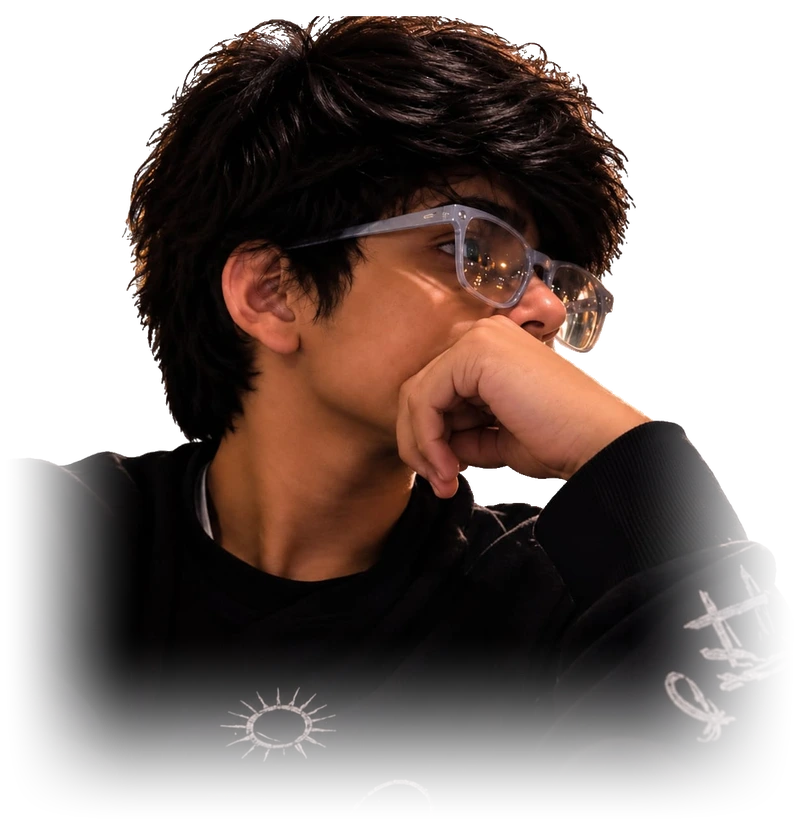
Axion, looking off to the side with his hand on his chin
saksham · axion · new delhi

One person. The whole product.

I design, build and ship websites, mobile apps and Windows apps, start to finish. I get the work done fast and working. I'm also looking for the right people to build companies with.

What I build ↓
Replies come on Telegram, straight from me.
01 · get something built

Bring me a problem. We'll work out the product.

Most people arrive with a goal, not a spec. I start with who it's for and what it should do for your business, then pick the simplest way to build it well.

1.
Websites & landing pages — Business sites, landing pages and online stores that explain what you do in five seconds and make it easy to get in touch.
2.
Web apps — Booking systems, dashboards, customer portals and internal tools: the software a business runs on.
3.
Mobile & Windows apps — Apps for your customers or your team. Mobile ones are designed for thumbs first. Windows ones are for work that belongs on a computer.
4.
Custom features & automation — Repetitive work handled automatically, background jobs, and direct connections to the software your business already runs on.
5.
Backend & integrations — Databases, APIs and the connections that make everything above work reliably.
tools i work with
HTML · CSS · JavaScript · TypeScript · React · Python · Rust · Swift · C++ · Cloudflare · AWS · Supabase · Vercel · n8n · REST APIs

Why people hire me:

You talk to the person building it.
No account managers, no hand-offs. Your questions go straight to me, and I answer them.
Business sense, not just code.
I ask how the product earns or saves money, what to build first and what can wait. That keeps costs down and launch dates real.
Fast, because of how I work.
I get the work done fast and working. I plan the structure cleanly, build with focus, and test everything thoroughly before it reaches you.
how it works

No surprises.

1.
You message me. — Tell me what you want and why. A few lines is enough.
2.
We talk. — A short chat or call. I ask questions and tell you honestly whether I'm the right person.
3.
You get it in writing. — Scope, timeline and a fixed price, agreed before I start.
4.
I build in stages. — You see working progress along the way, not one big reveal at the end.
5.
You own it. — Code, domain and accounts are yours. Small fixes after launch are included.
about my work

You won't find a gallery here.

What I've built stays private: websites, web apps, Windows apps, mobile apps, and a product of my own that's still in progress. I'd rather protect that work than turn it into a showcase.

Here's how you can judge me instead:

  • Talk to me. Ask how I'd build your project. You'll learn a lot in twenty minutes.
  • Start small. We can agree on a small first stage, so you see my work before committing to the rest.
  • Look at this site. It's fast, it works on a cheap phone, and every button does something.
02 · build a company

I'm looking for partners, not employees.

I have more business ideas than hours in the day, and one is already in motion. I can build the product myself. Next to me, I want people who are strong where I'm not.

Who I'd like to meet:
  • People with sales, marketing or operations experience
  • People who know an industry well and see its problems up close
  • Designers, and people with finance or legal knowledge
  • Developers who want to build products, not just close tickets
What I bring:
  • I can take an idea to a working product on my own
  • I make decisions with cost and revenue in mind
  • I'm in this for the long run, and I show up
What I'm not looking for:
  • Someone who wants to hand me an idea and wait
  • Anyone who isn't ready to put in real hours
How it starts:

Message me about who you are and what you'd bring. We talk. Then we try something small together before anyone discusses structure. I won't share my ideas in a first message; first we find out whether we work well together.

03 · business collaboration

A project, or a long-term collaboration.

A project.

One clear outcome. Fixed scope, timeline and price. It ends when the work is delivered and handed over. Best for: a website, a mobile app, or a desktop app.

A collaboration.

Ongoing. I work as an extra developer for your agency or team, or we build a product together. Terms are agreed case by case. Best for: agencies, product companies and teams with steady work.

Ways to collaborate:
  • Development partner for agencies, under your name or mine
  • Technology partner for startups and product teams
  • Joint products: shared idea, shared build, shared outcome
  • A long-term development relationship

I work solo. That means quick decisions and direct communication, and it means I'll tell you plainly when I'm at capacity.

04 · the universe

How did it all start?

Most of my nights end up in the exact same place: looking up and wondering how reality got here. If the universe had always existed, an infinite number of moments would have had to pass before today. But if it had a beginning, what was there before "before" was even a word?

I'm an amateur. No degree, no research grants, no claim of having solved cosmology. What I have is an obsession with stripping away dogma until only the structural skeleton of reality remains. Over the last year, I developed the Cosmic Rubber Band Theory: an intuitive, physics-grounded model of how energy stretches in the quantum vacuum, snaps into the Big Bang, and cycles forever—along with thoughts on the Great Attractor, cosmic bulk flows, and why consciousness exists.

An open invitation to curious minds

Whether you study physics, spend nights wondering how reality works, or hold a completely different view: I want to hear from you. Disagree with me? Even better. Every conscious mind is just a piece of the cosmos looking back at itself.

FAQ

Can I see something you've built?
Not publicly. My projects are private. On a call I can walk you through how I'd build yours, and we can start with a small first stage so you see my work before committing.
How much does it cost?
It depends on what you need, so I quote per project after a short chat. The price is fixed before I start, and I choose tools that keep your running costs low.
How long does it take?
You get a timeline in writing before we start. Simple sites move fastest; complex apps and larger systems take longer.
Who owns the work?
You do: the code, content, domain and accounts.
You're 16. Does that matter?
Not for the work: you get a scope, a price and a deadline in writing, and I deliver.
How do you work so fast?
I get the work done fast and working by focusing on the core product. I plan the architecture, build cleanly, and test everything before it ships.
What happens after launch?
Small fixes right after launch are included. New features and ongoing maintenance are agreed separately.

Ready when you are.

Tell me who you are and what you're after. I read every message myself.

Prefer Instagram? @Axion53100
1 of 3

What brings you here?

04 · original thoughts

The Cosmic Rubber Band: How It Started

01

The Core Question

"What existed before everything? If you peel away assumptions, only the structural skeleton of physics remains."

Most cosmological models hit a wall when asking how reality started: either everything popped out of literal nothing, or it stretched through an infinite past. Both seem impossible.

Energy cannot be created or destroyed. The Big Bang was a transition, not a beginning from zero.

By stepping back from dogma and examining how energy actually behaves, the pieces click together: reality is cyclic, elastic, and grounded in the quantum vacuum.

02

"Nothing" Cannot Exist

Try this right now: close your eyes and imagine nothing.

Not darkness—darkness is the absence of light, but it still exists inside space. Not silence—silence exists inside time. True nothingness means no space, no time, no geometry, no energy.

You can't do it. And physics agrees: under Heisenberg's uncertainty principle, a quantum field can never come to an absolute, frozen stop. Empty space is never empty; it is the quantum vacuum, constantly vibrating with irreducible zero-point energy and virtual particle pairs.

The Casimir Proof (1948): Put two metal plates nanometers apart in a total vacuum. The outside fluctuations push them together. The vacuum exerts real, measurable physical pressure. Empty space is alive with energy.

So the first pillar clicked: Absolute nothing has never existed. Energy has always been here.

03

The Cosmic Rubber Band & The Snap

If the vacuum always had energy, what made it suddenly ignite into our universe?

Think of a rubber band lying on a table. It has potential energy. Now pull it. Tension builds. The molecules strain against each other as elastic strain accumulates.

Energy has a stretching limit.

What happens when you stretch a rubber band past its limit? It snaps. All that stored elastic potential converts in an instant into kinetic motion, heat, and sound.

Now scale that to reality. Quantum vacuum energy is never static—it fluctuates. Small fluctuations happen constantly. But when fluctuations accumulate across spacetime, the elastic tension reaches a threshold: the extreme Planck density limit.

When the threshold is breached, the "rubber band" snaps and rebounds. That is the Big Bang. It wasn't a magical creation from literal zero; it was an elastic phase transition. Stored vacuum potential rapidly transformed into the super-hot soup of particles, radiation, expanding space, and time.

04

The Universe Breathes

Inhale, exhale, repeat.

After the snap, spacetime expands. Things cool down. Gravity pulls matter along the cosmic web. Stars ignite, heavy elements fuse inside supernovas, and planets form.

Then, chemistry gives rise to biology. Little 20-watt neural networks open their eyes—consciousness emerges. We aren't strangers visiting the universe; we are pieces of the universe that woke up so the cosmos could finally see and experience itself.

Eventually, over deep cosmic time, stars exhaust their fuel, black holes slowly evaporate through Hawking radiation, matter dilutes into diffuse photons, and the system cools back toward the ground state—setting up the tension for the next rebound.

05

The Great Attractor & The Multiverse Tug

Since the late 1970s, astronomers have observed something puzzling: our entire Laniakea Supercluster—100,000 galaxies, including our own—is hurtling at 627 km/s (2.2 million km/h) toward a gravitational sink hidden behind the Milky Way's dust plane: the Great Attractor.

Even after accounting for massive galaxy clusters like Norma and Shapley, cosmologists measure mysterious, large-scale "bulk flows"—vast rivers of galaxies drifting across cosmic horizons faster than standard models predict.

My Hypothesis — The Multiverse Tug: If our Big Bang was not a solitary fluke, but one of countless phase transitions in an eternal quantum vacuum, our universe bubble does not expand in total isolation. Neighboring universe bubbles in the multiverse could be exerting subtle gravitational tidal pulls across cosmic horizons. Gravity is the only force capable of reaching across universe boundaries.
06

Want to Know More? Let's Talk.

I don't offer this as dogma. I'm 16, curious, and questioning reality down to its roots. Every conscious mind holds its own perspective.

If you want to know more, explore the equations, or share your own thoughts on how the universe started: text me. Let's exchange views and talk it through.